Electricity Sales / Town Gas
The electricity sales and town gas dataset are based on actual or estimated electricity and town gas monthly meter readings collected by SP Services (SPS).
Dataset Update Frequency
| Dataset | Update Frequency |
|---|---|
| Electricity | Monthly |
| Town Gas | Monthly |
Trusted Center for Sensor Data (TCS) expects the data transfer from EMA on the 25th of every month. Latest available data will be available 2-months before current date (i.e. Jan readings will be sent in Mar).
Nature of Data Collection
Meters are read once every two months. On months where meters are not read, SP will estimate the bill based on the average daily usage between the last two actual reads.
Open Electricity Market
Since the introduction of the Open Electricity Market (OEM) in 2018, all residential and non-residential consumers have flexibility to choose where to purchase electricity.
Consumers can choose to buy electricity at the regulated tariff rate or wholesale electricity price with SP group or choose to rely on retailers from OEM to supply their utility consumption.
Pay-As-You-Use (PAYU) metering scheme
Households under PAYU metering scheme undergo a pre-payment approach to use credit balance to be charged by their electricity consumption. PAYU data is not included in the Electricity Sales dataset.
Fields
This segment covers detailed description and domain specific information of relevant fields in the Electricity dataset.
Account Number
For Town Gas, all account numbers are SP account numbers.
For Electricity, based on where the consumer purchases from, the account number refers to either the SP or MSSL account number. They are 10 characters long consisting of mostly digits, with some having the exception of - as the last character.
There are 2 types of accounts, depending on the purchase from SP or OEM.
- SP account: is the number issued by SP group for the premise when a utilities account is opened with them.
- Regardless of whether a consumer decides to consume from an OEM provider, they will still need to open a SP utilities accounts for water and gas charges.
- Example of SP account number in SP bill:
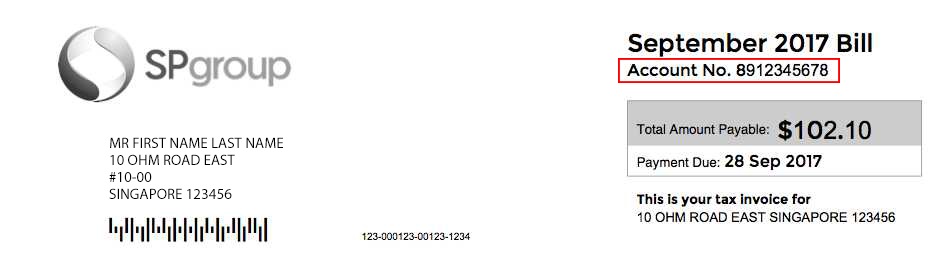
- Market Supply Services Licensee (MSSL) account: is the number issued by SP group when a consumer switched out to an OEM retailer.
- MSSL account number is tagged to the premise address and will change when the retailer stop supplying or when a new tenant is replaced.
- The MSSL number can be found in the retailer's bill or by contacting retailer.
- This account number is not equivalent to the OEM retailer's internal account number that they use for customer billing (Electricity dataset do not possess such information)
As the MSSL, SPS provides end-to-end market support services which include supply turn-on and disconnection, billing and payment collection, metering, data management and other customer services.
On how to identify meter reading, billing cycle and account number, please refer to this.
Contestability Status
(Not applicable to Town Gas)
There are 2 types of electricity consumers:
- Contestable: are customers of the National Electricity Market of Singapore (NEMS), which is operated by a licensed entity – SP Services.
- Non-Contestable: are customers who chose to purchase electricity from licensed retailers of OEM.
Please refer to Energy Market Authority (EMA) website for more information.
Consumption
The amount of electricity, town gas (in kWh) consumed by the account in a billing period. Since meter reading is every 2 months, the consumption figure may be actual or estimated. Please refer to actual_or_estimated column to find out.
In the event of a overcharge or undercharge, the consumption figure may reflect adjustments made in subsequent months' bill after the meters are read, to account for the difference between the estimated and actual consumed amounts.
Why are there multiple electricity consumption records for a single premise per month?
There are several causes:
- A transition between a contestable to non-contestable account (or vice versa) would reflect more than 1 consumption record to two accounts for the same premise.
- More than 1 classification of consumer type in the premise belong to same account. E.g. a landed premise can have consumer types of
BUNGL&GENCO; customers with embedded Intermittent Generation Sources*) - Beware of difference in suffix of the premise address where it might reflect differences in location of premises, e.g. common shared area vs. living area of residential premise
Embedded generators are entities who generate electricity primarily for their own use. They are required to apply to EMA in order to be classified as an embedded generator. They are allowed to connect to the grid, and can sell excess electricity.
Actual or Estimated
Indicates whether the consumption figure for a billing period is based on an actual meter reading or an estimated value.
Null values in this field typically occur for contestable accounts, where SP does not provide this information to EMA. There are various valid real-world reasons why this may occur, including:
Solar generation accounts (IGS)
For accounts where the category_of_market_participants field is populated as IGS (Intermittent Generation Sources), zero electricity consumption may be recorded while charges continue to be incurred. These accounts are associated with solar generation and may incur charges related to grid support services even when no electricity is consumed.
Active accounts with recurring MSS charges but no consumption
Some accounts record zero kWh consumption but carry a recurring_mss_charges_dollar value. This indicates the accounts remain active and continue to incur recurring Meter Reading and Data Management (MSS) charges despite having no recorded electricity consumption during the period.
Premises Type
Premise type code tagged to the account. The codes are owned by SP and submitted along with the records to EMA as part of regulation-required information requirements. It can be downloaded from the dataset page (Datafields -> Premises Type -> Usage guideline documents)
Please contact henry_lim@ema.gov.sg, ember_shen@ema.gov.sg if you require more clarifications.
Total Charges in Dollar
The amount of electricity, town gas consumed is charged in Singapore Dollars.
For electricity, this amount may or may not be charged in full by the retailers to the consumers. The apparent charges to consumer billed via OEM retailer directly will not be transparent to SPS and thus would not appear in this dataset.
For cost tally with physical bill, do ensure the billing cycles compared between dataset and actual bill are consistent.
How is the chargeable amount derived?
The charged amount is calculated as follows: SGD $ amount = usage in kWh * rate. If there are several rates, the amount would be the sum of product across the different rates.
Breakdown of Electricity Tariff
Electricity tariffs are regulated by EMA and revised quarterly to reflect the actual cost of electricity.
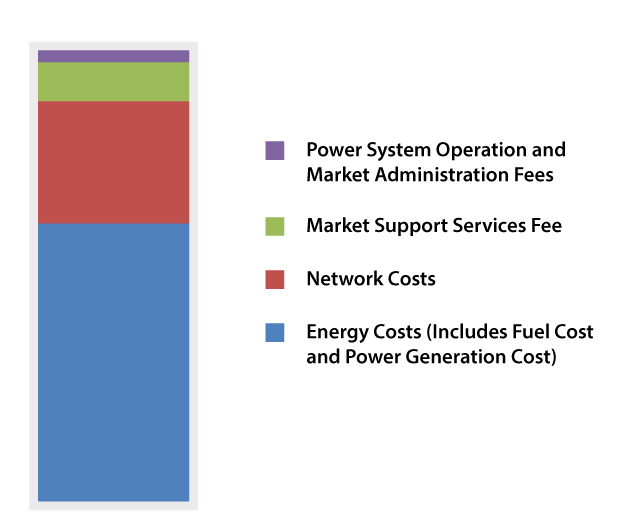
Click here to understand more about Electricity Tariff
Singapore Standard Industrial Classification (SSIC)
The Singapore Standard Industrial Classification (SSIC) is a 5 digit national standard code for classifying economic activities of companies.
The SSIC available in this dataset refers to the survey augmented SSIC from Department of Statistics (DOS), which is matched by UEN provided by EMA.
Background on Classification
Accounting and Corporate Regulatory Authority (ACRA) is the regulator of business registrations and the designated SSOT for SSIC information.
During a firm registration, SSIC codes are selected by firms where they can declare up to 2 SSIC codes, for their primary and secondary activities.Firms are also required to update their SSIC information with ACRA when there are changes to their activities (via ACRA’s online filing system).
While ACRA is the primary source of SSIC data, DOS will supplement and update SSIC code of firms (survey augmented SSIC), if a change is detected in their business activities through DOS’ sample business surveys or via feedback from Research & Statistics Units (RSUs) in other government agencies.
The updated SSIC codes are typically identified based on firms’ activity information/description, income and expense data from their financial statements or survey returns. For instance, a firm with mainly F&B sales income is likely to be in the F&B industry. SSIC codes are also updated based on information provided by the firm on their activity during agencies’ interaction with the firms.
Both ACRA-registered (primary, secondary) and survey augmented SSIC are available in DOS TC, with usage guidelines.
Additional Scope Filters
Scope filters allow users to filter the dataset to a specific subset of data. Apart from filtering by the existing datafields like UEN or Postal Code, users can also filter by the following custom scope filters.
Note that these scope filters are derived fields and are not part of the core datafields.
| Scope Filter | Required Columns | Description |
|---|---|---|
| Is Residential | Sector | Is_Residential reflects these 5 different "Sectors": "Households", "Commercial", "Industry", "Transport" and "Others". Sectors are pre-tagged by EMA. As a filter, Is_Residential can be set to "True": Filters rows where Sector is "Households"; or "False": Filters rows where Sector is NOT "Households" Water consumption uses "Billing Class" to filter. Please refer to the FAQ for water here |
| District Number | Postal Code | Uses the first 2 digits of the postal code to map to a district number (eg. postal code 67xxxx maps to District 23) |
| Region Name | Planning Region | Uses the region code in 'planning region' to identify the geographical region associated with the data. (eg. West/North) |
| Planning Area Name | Planning Area | Uses the planning area code in 'planning area' to identify the specific planning area associated with the data. (eg. Sembawang/Punggol) |
| Subzone Name | Subzone Number | Uses the 'Subzone Number' to identify the specific subzone associated with the data. (eg. Bugis/Bidadari) |
FAQ
Why are there multiple records for a single account no. in the same month?
- Such cases occur when that particular entity has connected both a load (consumption) and generation (solar pv) meters in the same account and location. The record with the generation will show a consumption value of 0 and have a premise type code = 'GENCO'. Energy generated by the solar pv is not reflected in this dataset.